
TRAGIC DEATH OF PADDOCK WOOD SOLDIER ON HMS HYTHE October 1915
It was a tragic day when news reached Paddock Wood, High Brooms, Southborough and Tunbridge Wells of the sinking of HMS Hythe on 28th October 1915. A large number of local men including John Victor Thomson (known as Victor) from Paddock Wood drowned at sea when HMS “Hythe” collided with HMS “Sarnia” another British troopship, off Cape Helles, in the Aegean sea only seventeen days after they had left from home to join the conflict in Turkey.
Victor was the son of the head gardener at Mascalls and the Thompson family were living in Mascalls Cottage, Paddock Wood where they had been living since at least 1901.
At the age of 24 years and 9 months, described as a mechanical engineer, having formerly served with the East Kent 2nd Battalion Volunteers, John Victor Thompson enlisted as a Sapper (1509) in the Royal Engineers 1st/3rd Kent field company on 4th November 1914 at Tonbridge.
The 1/3rd Kent Fortress Royal Engineers had been formed on 1 May, 1914. It was initially a territorial unit recruited from Tunbridge Wells and the surrounding villages and was colloquially known as The Sappers. It included a band of forty five musicians - both a brass band and a drum, fife and bugle band. The Company's initial training took place in Sheffield Hall, Draper Street, Southborough, then in the former gasworks in Speldhurst Road, which was later converted into a well-equipped drill hall.
In the initial stages of the war, the company continued to train at home, and became a works unit responsible for protecting coastline, searchlights and defence facilities allowing regular soldiers to join the British Expeditionary Force (B.E.F.).
In July 1915 it was at least 185-strong, consisting mostly of tradesmen. Military engineers or “sappers” could use their trades in the army and earn the equivalent of 58-11p a week, whereas infantrymen earnt much less.
The Company had a farewell dinner on 11 October 1915 and was cheered off by crowds as it left on Train Number 13. They sailed from Devonport on 13th October in the converted liner “Scotian” bound for Gallipoli via Mudros. The men were transferred to HMS Hythe on the morning of 28 October. The Sappers were desperately needed to fill the vacancies caused by the appalling losses in the Dardanelles.
The Hythe was a former cross-Channel steamer between Dover and Calais. Owned by the South East & Chatham Railways she was launched in 1905 and converted to a minesweeper in October 1914, with two 12-pounder guns.
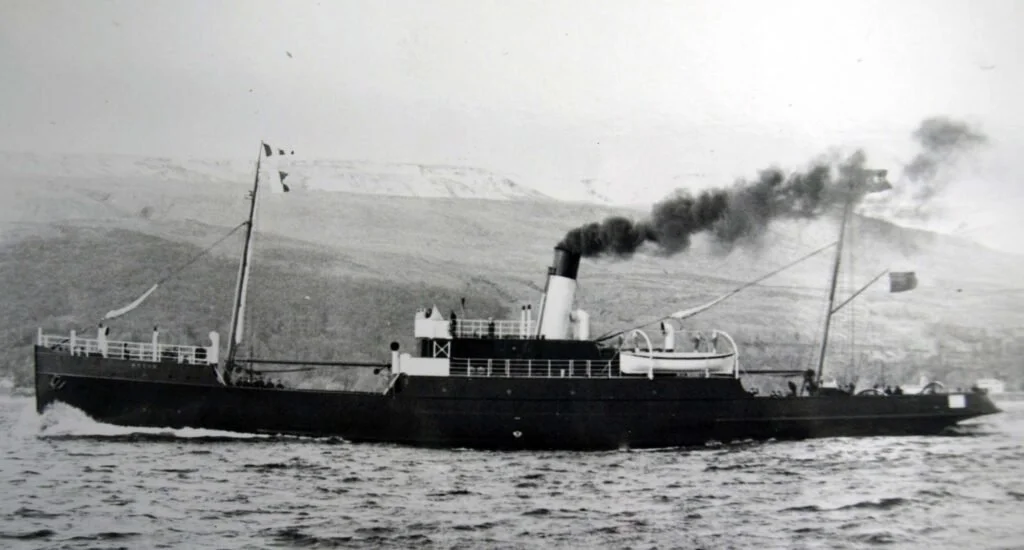
HMS Hythe
In 1915 she was sent to transport troops to and from the Dardanelles. But she was totally unsuited for the work as she had no passenger accommodation. The Army officers were allowed to enter the engine room to keep warm but the men crowded the decks. Because of the weather and the choppy seas, a fabric awning was erected to provide some overhead cover against rain and spray, and many of the soldiers huddled underneath. This was very much a family unit, with many knowing each other through school, cricket team, football team, living in the same road etc. The ship was apparently top-heavy when she set out from Mudros at 4pm on 28th October for the 50 mile journey to Cape Helles on the Gallipoli peninsula, travelling without lights to avoid attracting enemy attention.
With some 40 minutes to land, at about 8pm a warning went out that another ship was bearing down on her. The ship was about to collide with the HMS Sarnia in the Dardanelles Straits.
HMS Sarnia, another ferry steamer, was bigger than Hythe and had a top speed of 20 knots. Having already landed her cargo and troops she had left port whilst the Hythe was just about to enter, steering on course S67°W as Hythe headed N82°E – near head-on.
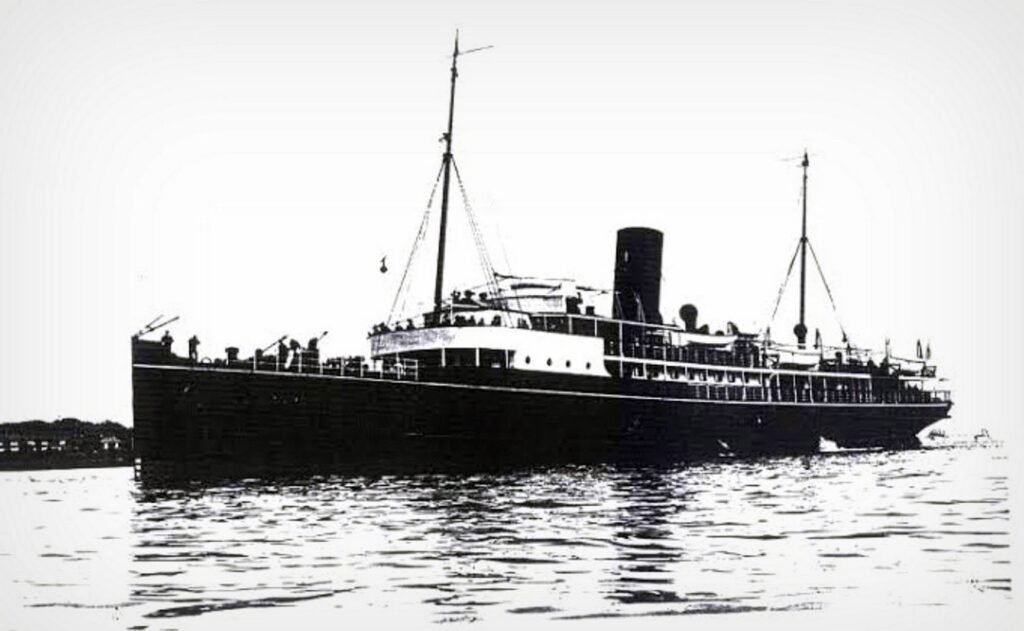
HMS Sarnia
The Hythe, in line with naval procedures and so as not to be seen by the Turkish gun batteries inland, was sailing with her lights out for her own safety and that of the troops she was carrying as well as her own crew. As the two ships were passing each other they collided and the Hythe sunk in only ten minutes. The troops had been preparing to disembark when the warning went out, and both ships were travelling at around 12 knots. Several attempts were made on both ships to change course – but apparently neither slowed down.
In the darkness, confusion reigned and it was reported that out of the 275 men on board HMS Hythe 154 of them, which included 11 members of the ship’s crew, drowned in the cold waters of the Dardanelles. Of these, 129 were reported to be from the 1st/3rd Kent Field Company, Royal Engineers.
Driver Fred Mills, from Speldhurst, was one of those who watched the disaster unfold and survived. He saw the Sarnia bearing down on the Hythe just seconds before the collision. The Hythe’s crew had just time to give a warning blast on the siren before the Sarnia hit them forward of the bridge, ploughing into the little vessel’s side, almost cutting her in two. The Hythe’s commander, sensing that the ship was about to go down, called to Captain Salomons, “Come on, jump. This is your last chance. I am going now." But Salomons stood firm, saying, “No, I will see my men safe first”. He went down with the ship as it slid under the waves.
There is a letter in the museum, written to Col Sir David Lionel Salomons by Hythe survivor Major Alfred Ruston: “At the beginning, the two vessels clung to each other for a few minutes and about 50 men and several officers scrambled across onto the other vessel,”.
Sarnia struck Hythe 8m from the bow on her port side, so forcibly that her bows cut halfway into Hythe, stopping her dead in the water. Her foremast fell onto the awning and many died in those first moments, as Hythe swung round by the stern and water rushed into the gaping hole in her port side.
Some of those on deck managed to step aboard Sarnia, which remained alongside for several minutes. Others leapt into the cold sea without life-jackets and only debris to cling to – few of the soldiers were able to swim.
One street in High Brooms was particularly hard hit – seven men who all lived along Silverdale Road in High Brooms died. It has been said that the postman delivering news of their death along this road became so overwhelmed by the distress his delivery was causing, that he turned back to his depot before he had completed his round. The names of the dead who were lost on MS Hythe are commemorated on the Helles Memorial in Turkey. The Memorial commemorates the names of 20,879 identified men from the UK and India. who lost their lives in operations throughout the Gallipoli Peninsula as well as those who either died or were buried at sea in the surrounding coastal waters.
On November 26th 1915 a service was held in St Andrew’s Church, Paddock Wood in memory of those who have lost their lives, especially two from this parish namely Private Thomas Randall of the Royal West Kent Regiment who was recently killed in action in France and Private Victor Thompson who drowned in the disaster to HMS Hythe. The church was well filled and the service was conducted by the Vicar the Rev G B Charles who gave a short address.
There is a memorial tablet in memory of the men of the 1st/3rd Kent Field Company, Royal Engineers who lost their lives when HMS Hythe was sunk at St Matthew’s Church which is located at High Brooms Road, Tunbridge Wells. It has been there since 1969 and prior to that it had been hung on one of the walls at the old Southborough Drill Hall in the town.
This memorial was paid for by Sir David Salomons as a tribute to his only son and heir, David Reginald Salomons, who died during the sinking of HMS Hythe on 28 October 1915. A marble plaque was unveiled a year later to the day at the Drill Hall, Speldhurst Road, Southborough on 28 October 1916. It was relocated into St Matthew's Church in High Brooms, Tunbridge Wells in October 1965. The rededication on 22 June 1969 was attended by five survivors of the Hythe.
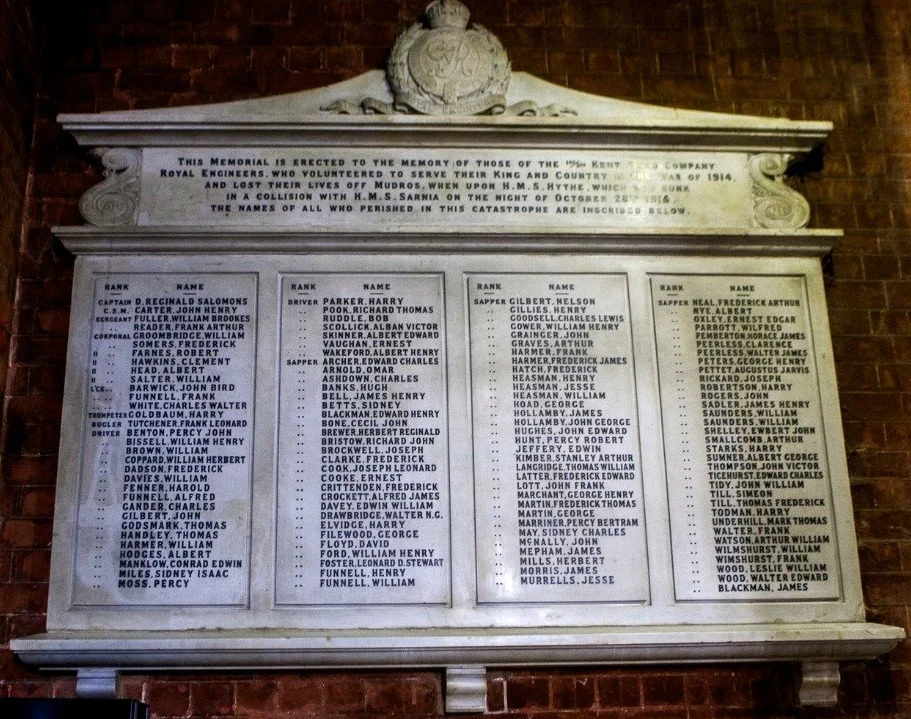
The Hythe Memorial in St Matthew’s Church, High Brooks, Tunbridge Wells
For many years, on 28th October, the survivors of the Hythe disaster, and the families of those lost held a “Hythe Sunday” service and paraded from the Drill Hall in Speldhurst Road to Southborough War Memorial, where twenty-four of them are named.
Two houses, Hythe (No 8) and Sarnia (No 6), in Gordon Road, High Brooms were built in the 1930s for a survivor of the Hythe disaster, Edmund Cavie. Several street names in Southborough still have a “Hythe” theme. eg Hythe Close in London Road, Southborough.
Victor Thompson is commemorated in the following places:
Helles Memorial, Turkey
A Wooden war memorial plaque in St Andrew’s Church records the death of John Victor Thompson
Paddock Wood War Memorial, where strangely he is recorded as W Thompson.
The memorial in St Matthew;s Church, High Brooms, Tunbridge Wells.
Article written by Meryl Flashman with thanks to:
The Southborough Society 2025
Article from Divernet 22 September 2022
Judith Johnson: Southborough War Memorial
Stephen Wynn - Tunbridge wells in the Great war
Roll of Honour.com
Southborough Sappers of the Kent (Fortress) Royal Engineers by Frank Stevens (out of print)