
Gift of a bass drum to Mascalls School, Paddock Wood
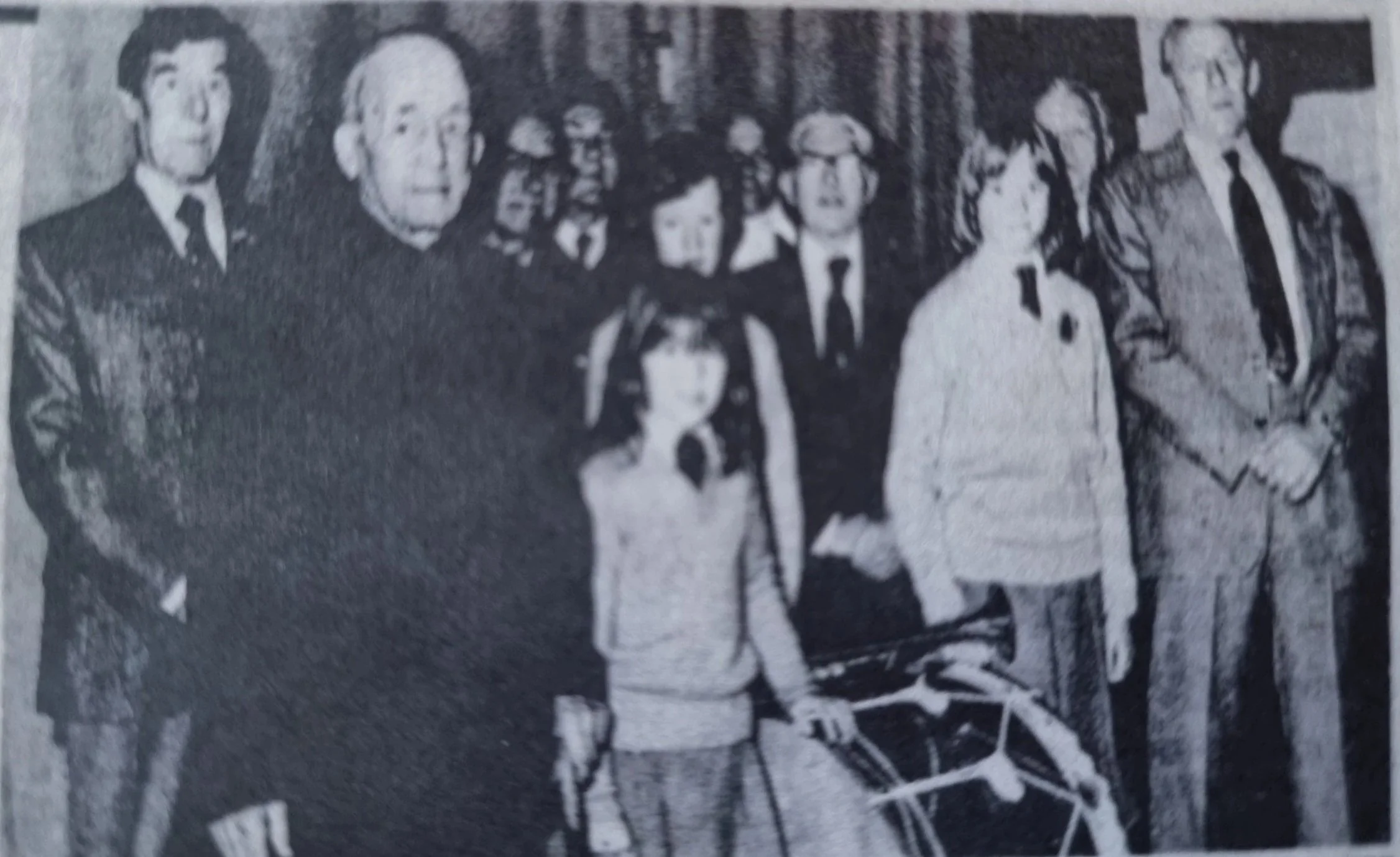
Members of the Paddock Wood and District British Legion hand Mascalls School a drum and six fifes at a remembrance assembly at the school on Friday. In the front row from left to right are Mr William Woodgate, Rachel Hewish, David Parsons, Alison Cordell and Mr Bert Joyce.
On November 16th 1979 the Courier reported that a bass drum that once belonged to Capel British Legion Drum and Fife Band - was presented to Mascalls School, Paddock Wood, on Friday, during a special assembly for Remembrance Day.
Making the presentation, the Chairman of Kent British Legion, Mr. Bernard Bulcraig, told the children from the Lower School: "I hope you understand that this is given, for safe keeping, with love."
With Mr Bulcraig for the presentation were members of Paddock Wood and District British Legion, including two veterans of the 1914-18 war. Mr Reg Ewins, Chairman of the Paddock Wood branch and Mr William Woodgate, a former side drummer in the Capel Band, both of whom were wounded on the Western Front.
Other members of the party were younger veterans of the Second World War, Mr. Bert Joyce, who once played the bass drum in the Capel Band, Mr. Sam Joyce, Mr. Jack Walker and Mr. Gordon Seale.
Mr. George Twort, former bandmaster of the Capel Band and one of its founders, was unable to attend the ceremony because of indifferent health, but he sent along a set of fifes and a flute, which had also belonged to the Band. Mr. Twort was also a veteran of the 1914-18 War.
The formation of the Capel British Legion Drum and Fife band on July 28th 1932 came about as the result of an idea of three first world war veterans – Isaac Ellis, Don Taylor and George Twort.
Isaac Ellis undertook to be secretary, Don Taylor an old ex Buffs drummer was to be bandmaster, and George Twort, tutor for flutes and fifes.
Each of these men had first hand knowledge of Regimental Drum and Fife Bands and realised exactly what was needed.
Some four or five other members, including honorary members with some knowledge of a flute were roped in, as were a couple who had played around with a kettle drum. The band was given to understand that it was to be responsible for its own finances and so a meeting was called with a view to finding means to raise money.
The Chairman of the band was to be Mr J.H. Jones the local butcher and he started the finances with a loan of 30/- over an indefinite period. This was later raised to £4. Further to this each proposed member of the band was to pay a penny per week into the Band fund.
An old bass drum and two kettle drums were obtained from a defunct scount band and 11 flutes were purchased.
At the next meeting the treasurer reported £1.17 ½ in hand, debts were £1.10.0 leaving a balance of 7/0 ½ .
From this point the band progressed and practice started. Marching was practiced around the headlands of Moat Farm Hop Gardens to the tune of Around the Marble Arch. After about six weeks the bandsmen were so fed up with the Marble Arch that they never played it again.
By May 1933 the band was so proficient that it was decided to purchase uniforms and the following was taken from the minutes of a meeting held on Saturday 3rd June 1933. “Proposed by J Rideout and seconded by Mr W Passy that the band pays £5.0.0 deposit and each member pays 1/- per week and should a member give any reason why he is unable to pay, it shall be made up from the Band fund.”
This was adopted and 24 suits of uniform – made to measure- were issued to the Bandsmen and with fund-raising efforts including stopwatch competitions, football sweepstakes and a two-hour revue, written and produced by the Bass Drummer called The Scarlet Girls, enough money was raised to repay each man back the money he had paid. Four new Guards Tub Drums and an ornate apron for the bass drummer was purchased and the Band was now complete.
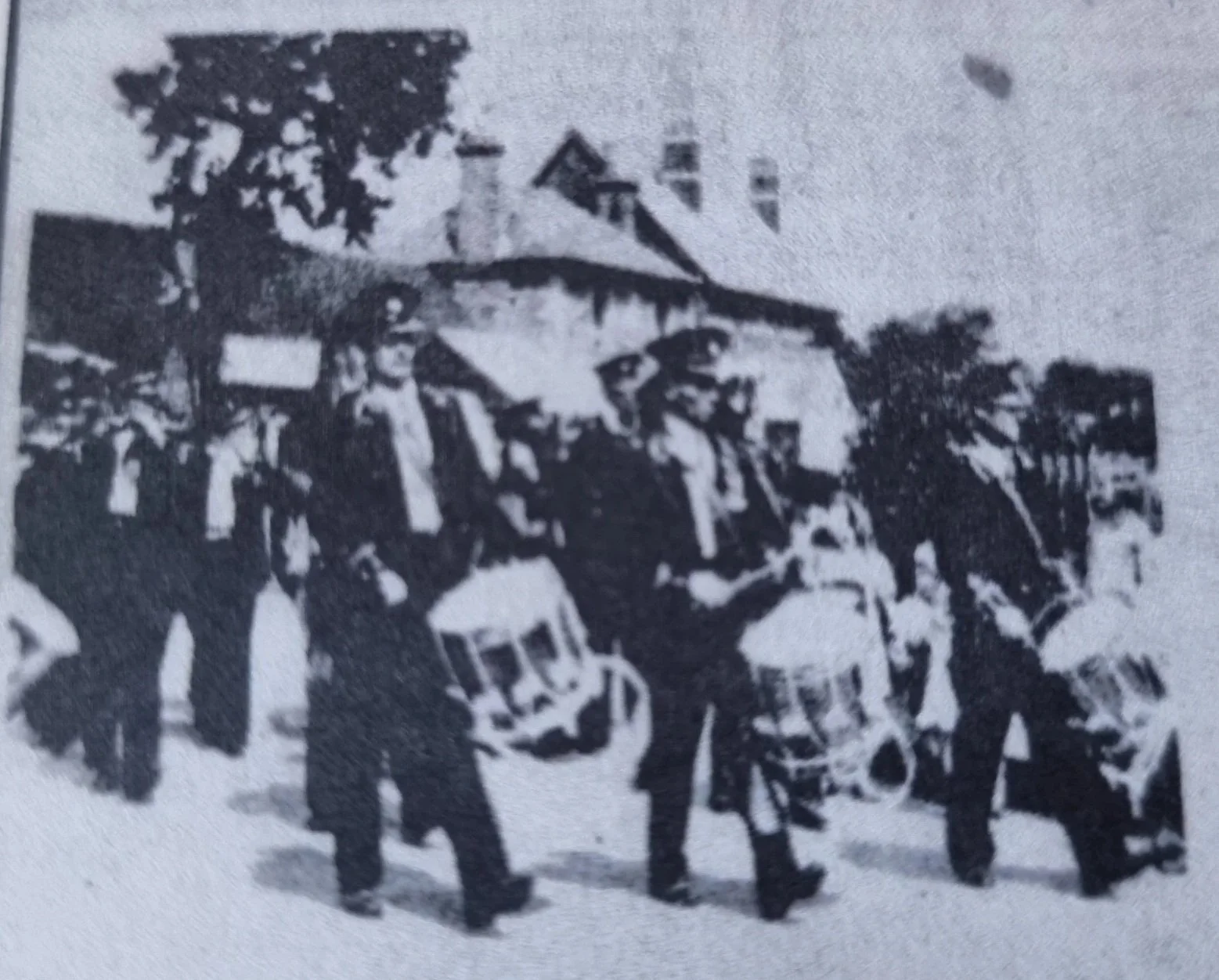
Capel Drum and Fife Band during the 1930s
The band was in great demand in the surrounding district for church parades, Hospital Sunday parades and Armistice parades. In 1934 they attended the British Legion (South Eastern) Rally in Brighton, where it is estimated more than 25,000 took part in the parade.
The Band continued for a time with G Twort and then F Rushant as Bandmasters and when the Second World War came only one Home Guard parade was held after which the band ceased to operate. An attempt was made in 1948 to get it going again and one Armistice parade was held, but with moth eaten uniforms and the lack of interest it just faded out.
The instruments were stored in various lofts and attics. The side drums disintegrated and gradually many of the others disappeared. But the bass drum was kept safely at the King's Head, Five Oak Green, and Bert Joyce, who carried it in many a parade in the past, cleaned it up for the presentation to Mascalls. The bearskin apron had been used as a pram cover for his first child, then as a rug and finally it wore out.
Thanks to the original minutes by the secretary Mr Isaac Ellis and later handed on to Mr E Ellis his son and passed to Heritage Paddock Wood Archives
AND The Courier November 16th 1979