Little Hoppers
On the main road between Paddock Wood and Tonbridge lies Hoppers, a grade two listed building, which has a long and interesting history, connected to the hopping industry at some point.
The building, originally a farm house attached to Kippings farm exchanged hands a number of times during the 17th and 18th centuries. In 1822 the building was bought by John Bowles senior a builder and carpenter. When he died two years later the property was left to his wife and 8 children in equal shares.
John Bowles junior bought out the others in 1855 and under him there seems to have been a period of expansion with the development of the premises as a beer house.
In 1876 the beer house was sold for £605 to Edward and Henry Kelsey who owned the Culverden Brewery in Tunbridge Wells.
Looking through the 19th century censuses the first mention of a beer house by the name Rose and Crown was in the census of 1881 when William Clinch, blacksmith was the licensee and occupant along with his wife and two children.
By 1891 the occupant was John Wood, painter, from East Peckham, his wife Kate and their three children. By 1901 the Rose and Crown beer house had changed hands again and was occupied by Ernest Ford, beer house keeper, his wife Kate and their son Edward.
When Edward Kelsey, the owner of the pub, died in 1903 he left the Rose and Crown to his sons and Adelaide Tolhurst the wife of William Tolhurst. The sons sold out to Adelaide who, after the pub was closed at Christmas 1909 under the Licensing Compensation Act, leased the premises for a year and then sold it in June 1910 to a charitable body based in London known as the Red House. The property was run on their behalf by the Rev. Richard Wilson Vicar of St Augustine's, Stepney.
An edition of The Kent and Sussex Courier dated 4th June 1910 reported that the premises had been acquired as a temporary hospital for the benefit of hoppers during the picking season.
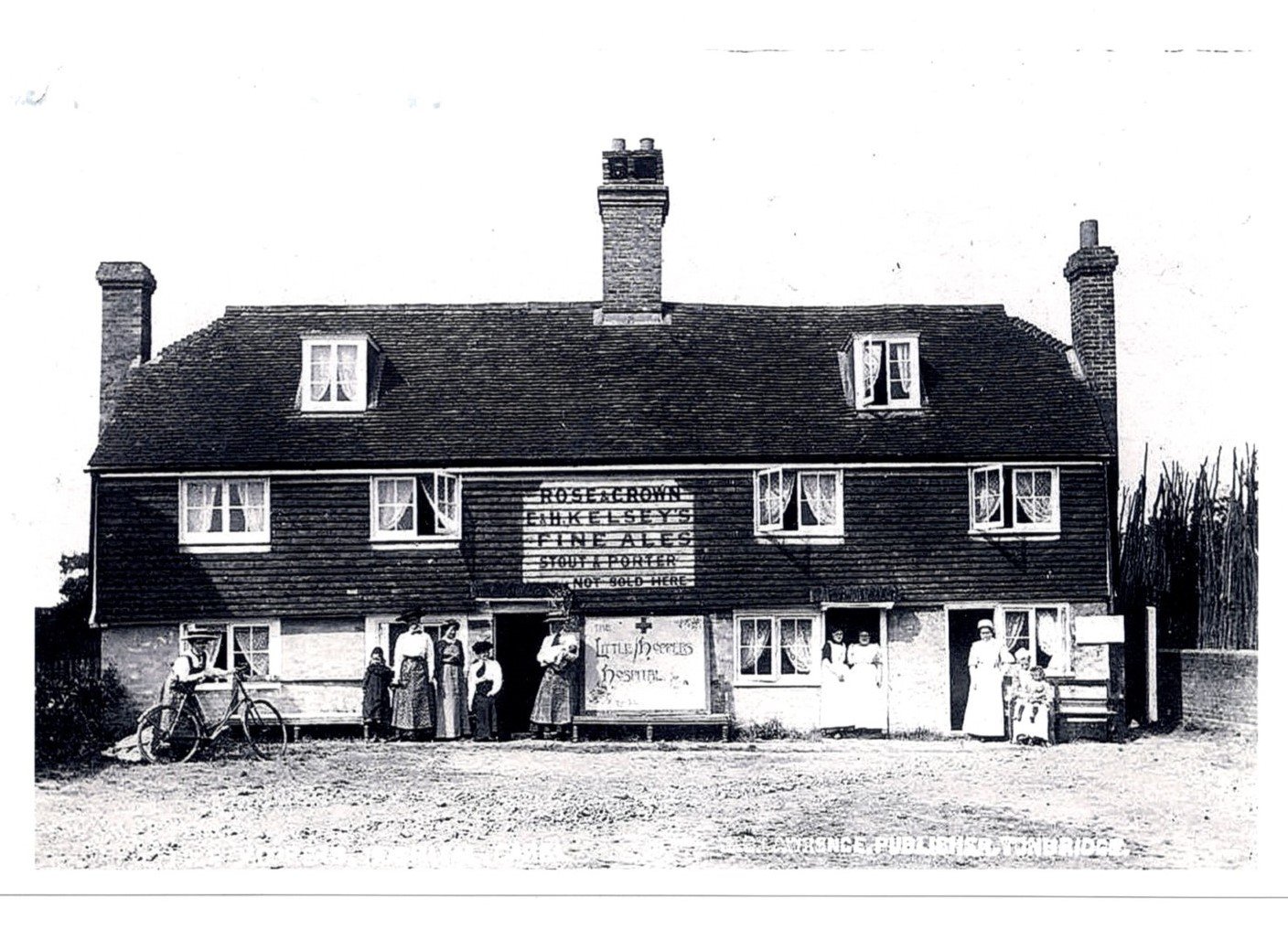
Little Hoppers Hospital formerly the Rose and Crown Pub
After refurbishment, the building became known as the Little Hoppers' Hospital. Its purpose was to care for hop pickers and their children who'd come down from London's East End to pick hops. It comprised a small medical ward accommodating up to 10 patients During the hop picking season trained nurses were on duty 24 hours a day.
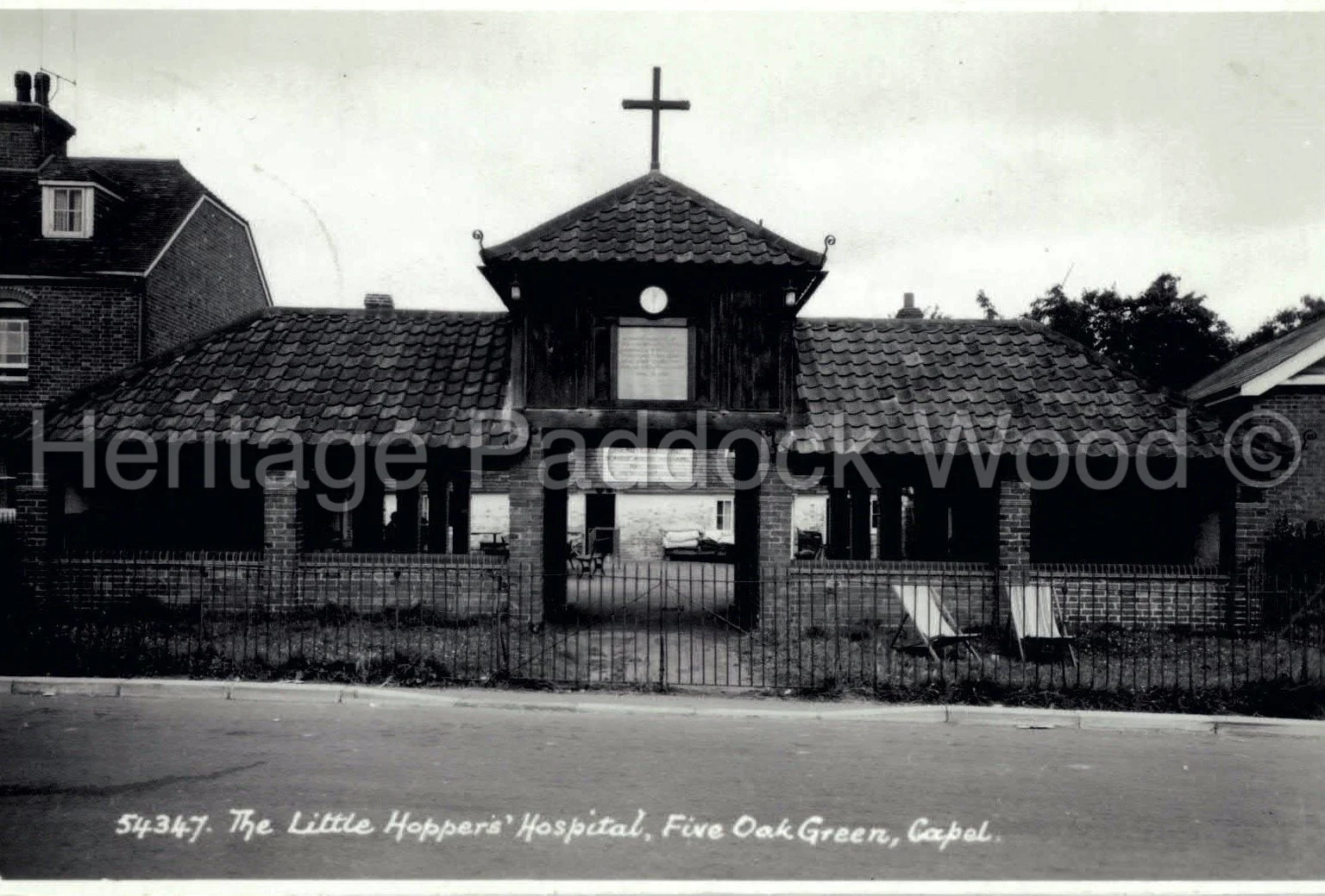
The front courtyard was built as a war memorial using money left to the charity by Mr Charles Saunders, who was killed in World War One. Opened in September 1925 it was paved with bricks, had a loggia built on three of its sides, and had an entrance from the road. The roofs were tiled to match that of the old building and the brick pillars were painted white. Its arcades provided shelter in bad weather and in one of these was an open fireplace. In 2010 when thieves stole lead from the roof a pair of tiny shoes were found hidden in the courtyard fireplace chimney. They would have been hidden by the builders of the chimney in the 1920s to bring good luck and fertility to the property.
Richard Wilson died in May 1927. He was lovingly referred to by his family as Uncle Dick; the people of Stepney called him Father Wilson and the press dubbed him 'The Hoppers Parson'.
With the increasing mechanisation of hop picking, the use of the Little Hoppers' Hospital decreased and the last entry in the hospital register was dated 1953.
By the 1970s Little Hoppers Hospital was all but redundant and the trustees obtained Charity Commission permission to sell the property but, due to the restrictions imposed because it was a listed building the proposed buyer withdrew.
Unable to sell the Little Hoppers' Hospital, the charity instead decided to develop the property and in 1981 it was reported that volunteers from 90 London parishes were involved in renovating it with the intention of it reopening as a residential social centre for parish groups from the East End. A main focus was also to give children from the inner city a taste of country living.
Improved living standards in the 1990's brought demands for more amenities. In 1996 the old hospital ward was converted into a modern kitchen and dining room. Bathrooms were installed and one of the rooms in the old house was designated as a Chapel.
Today Hoppers belongs to a charity which is run mainly by volunteers and is advertised as Christian holiday accommodation and conference facilities.
Above the entrance is inscribed:
"In happy memory of Old Friends who loved
hopping and who loved this place very
dearly who gave their lives for Old England
and for us, 1914-18. Lord all pitying,
Jesu blest grant them Thine Eternal rest."