
The Paddock Wood to Hawkhurst Line
The Hawkhurst branch line was opened to all traffic on 4 September 1893. It was 11½ miles in length and trains were provided and operated by the South Eastern Railway, later the South Eastern and Chatham Railway which was absorbed into the Southern Railway in 1923, and finally subsumed into British Railways in 1948.
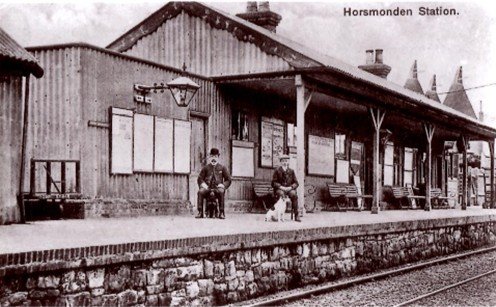
Horsmonden Station
The line was single track for all its length but passing loops were provided at each of its intermediate stations. All the branch trains started from Paddock Wood after which the stations were Horsmonden, Goudhurst (originally named Hope Mill for Goudhurst and Lamberhurst), Cranbrook and Hawkhurst but the latter was not actually built as a terminus because it was anticipated that the line would continue south, a concept which never materialised.
The route was steeply graded and incorporated two tunnels, Horsmonden Tunnel (86 yards) and Badgers Oak Tunnel (178 yards). There were also two sidings, one at Churn Lane (more or less midway between Paddock Wood and Horsmonden) and the other at Pattenden just south of Goudhurst. Churn Lane’s original function was to take on board hop pockets (sacks) for onwards transportation but in later years it was used to store wagons awaiting either repair or transmission to Ashford scrapyard. Pattenden was used mainly for agricultural traffic and in particular for reception of shoddy (wool and cotton waste), a highly effective fertiliser for hops.
The line ran through beautiful countryside and passengers would see on their journey hop gardens and oast houses, orchards, woods, narrow valleys and hills, all against a background of period Wealden farm buildings. However a major drawback throughout the whole of the line’s existence was the inconvenient placing of its stations. Only Horsmonden was near to its village; Goudhurst Station (the only one to have two platforms) was a mile from the village, Cranbrook Station was nearly two miles from the town centre and Hawkhurst Station was at Gills Green (one and a half miles from Hawkhurst along a very hilly road).
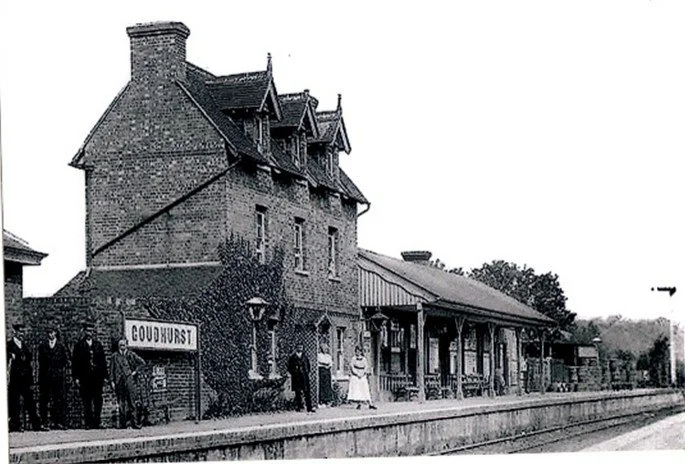
Goudhurst Station 1913
Like other branch railways the Hawkhurst line catered for both passenger traffic and freight. The latter consisted mainly of coal, fertilisers and feeding stuffs plus groceries inwards; grain, fruit and hops outwards. At Horsmonden the passing loop was used to serve an adjoining fruit packing warehouse from which loaded wagons mainly of apples were despatched to all parts of the country. There was also a small goods yard. Goudhurst Station had no specific goods facilities but it was able to derive revenue from the nearby Hope Flour Mill and the adjacent cattle market. It also had a particular claim to fame in that it starred in a children’s TV serial screened in 1960-61 called “The Old Pull and Push”. At Cranbrook there was a coal depot and a “goods only” loop which served a spacious goods yard and a corn warehouse. Hawkhurst was able to boast an engine shed, a water tower and the most extensive goods yard on the branch, together with a number of sidings.
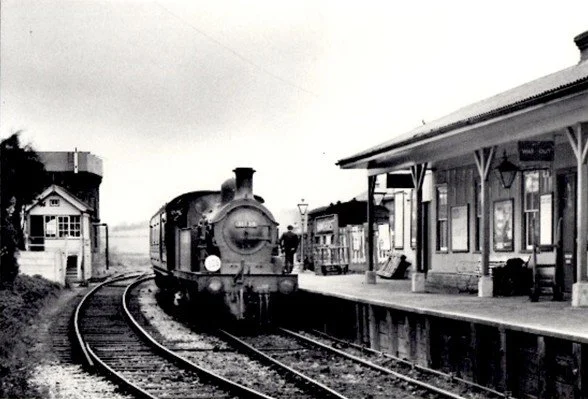
Hawkhurst Station 1961
Passenger services on the line never really took off. The regular customers comprised only a handful of commuters for Tonbridge and London and in term time there were a number of schoolchildren travelling to and from Tonbridge. But apart from these, few trains carried more than a dozen passengers. The only exception to this came during the 3-week hop harvest when several thousand hop pickers plus visitors descended on the area; in the busiest period additional trains known as Hopper Specials were laid on which ran through to the branch from London Bridge via New Cross or New Cross Gate. Since the hopping harvest generally coincided with the end of the holiday season, most serviceable trains were already in use elsewhere, so spare rolling stock would be brought out of storage and pressed into service; sometimes carriages had to be borrowed from other parts of the country. The carriages tended to be old or in poor condition, since the hoppers had something of a reputation for drunkenness and violence. All these extra services were organised by a "Hop Control Centre" at Paddock Wood which ensured that pickers were allocated to the correct areas.
One other source of traffic on the line were the boarding schools of Benenden and Cranbrook. Benenden Girls School (for which Cranbrook was the station) was served by a special train to and from Charing Cross but boys from Cranbrook School had to use the normal service. At end-of-term time there were so many trunks and other school items to be transported that additional utility vans had to be drafted in.
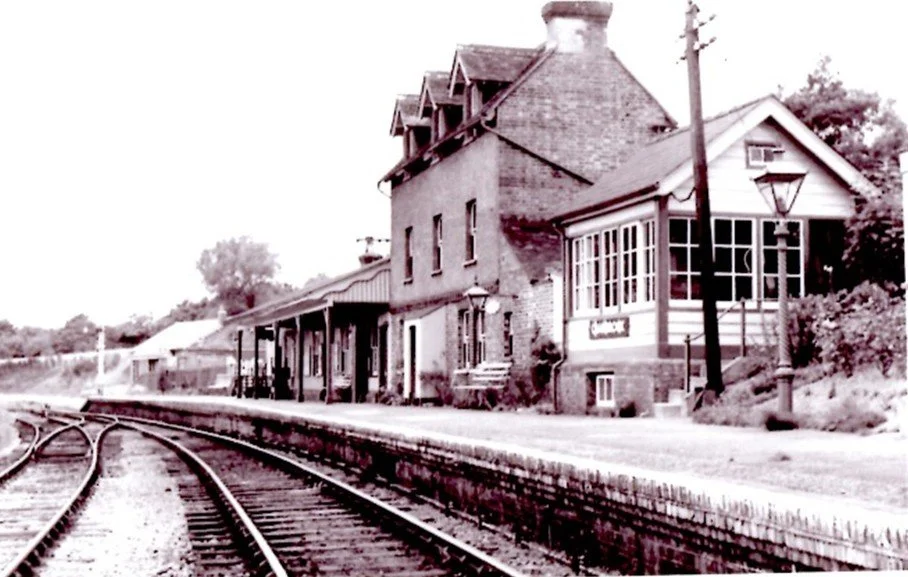
Cranbrook Station
In 1958 however the line suffered a major blow when M & D Motor Services were engaged to provide special buses for the schoolchildren thus losing the branch the mainstay of its passenger service. At the same time the hop picking workforce was fast declining as a result of rising living standards and paid holidays. Those hoppers who did remain now chose to travel by car or van but in any event mechanical pickers were by now replacing the human workforce.
Against this background the line could no longer survive and on 12 June 1961 all services were withdrawn permanently. As one commentator put it: closure was like the death of an old friend, sad but inevitable. But even if it had not been closed when it was it would undoubtedly have been a victim of the Beeching Report of 1963.
Following closure the branch stood disused for two and a half years. During this time the stations, with the notable exception of Cranbrook, suffered greatly at the hands of vandals. The rooms within the buildings quickly deteriorated once they became exposed to the wind and rain and the exterior buildings themselves were subject to senseless destruction.
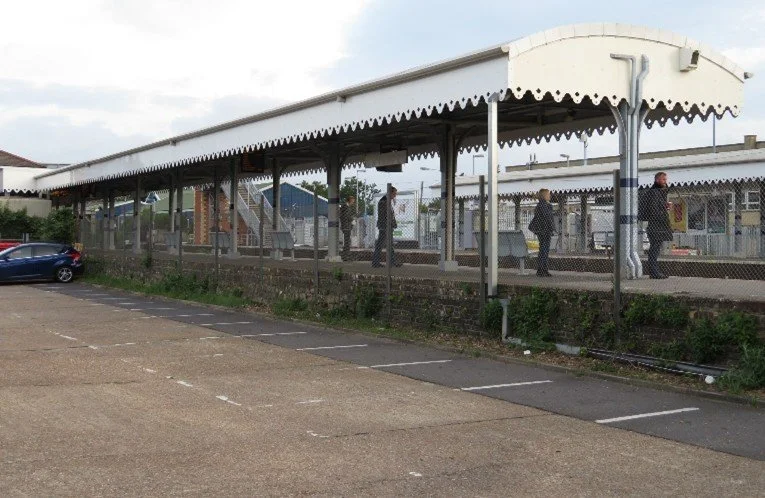
Former platform at Paddock Wood
In 1964 the track was lifted and a couple of years or so later large parts of the route including the stations were subsequently sold off by British Rail. At Horsmonden the station buildings were acquired by a garage proprietor and whilst much of the original happily still survives, the former goods yard became very overgrown and the deep cutting beyond was filled in. The former stationmaster’s house is now a private residence and survives in an excellent state. At Goudhurst no trace whatsoever now exists of the station as the whole site was sold off in 1967 and the area was cleared. Subsequent road widening together with new housing has removed all evidence of the former railway including the level crossing. By way of contrast, Cranbrook station has been well preserved and it together with the station master’s house and the former signal box have been converted into a well-cared for private residence. The goods shed together with part of the goods yard still survives and the area is now used as a Gas Distribution Centre. The former station at Hawkhurst, at the end of the line, is now a wood turnery yard. The original pedestrian access steps up from the road to the station are still there but although the station building has been demolished the goods and locomotive sheds still survive (as does the signal box but this has now been transferred to the Kent and East Sussex railway at Tenterden).
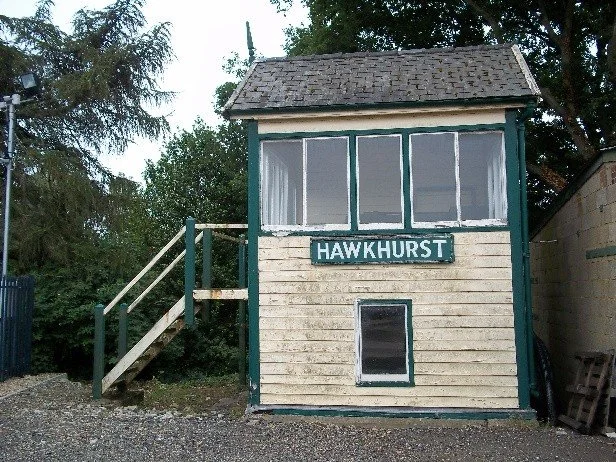
Hawkhurst signal box
At Paddock Wood, where the Hawkhurst branch began and terminated, a few features remain. The bay from which most of the trains started was converted into a car park in the early 1990s. The platform with its brick edging has been fenced off but is still there together with the original platform canopy. Some short sections of track remain adjacent to the Network Rail Training Centre to the east of the station.
As might be expected the route of the Hawkhurst branch line itself has changed considerably in the years since closure. A fair proportion of the former permanent way has been taken back into cultivation and is now difficult to trace as a result of ploughing and other agricultural activity. Some embankments have been bulldozed (often to prevent flooding), some cuttings have been filled in and levelled and many boundary hedges and fences have been removed. The two tunnels on the route, at Horsmonden and Badger’s Oak, are however well preserved.
Particularly well preserved stretches of former track are located to the north of Horsmonden, near to Swigs Hole Farm where there is an impressive brick bridge and embankment, and also towards Cranbrook Station where parts of the platform survive.
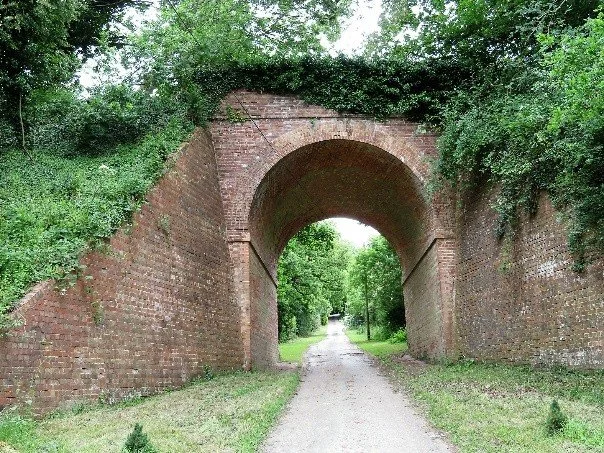
Bridge and Embankment at Horsmonden
The route provides a local ecological and potentially recreational source and, in order to preserve it as a heritage asset (as well as celebrating the link with hop picking in the area), the Hop Pickers Line Heritage Group was set up in 2008. In partnership with Tunbridge Wells Borough Council (TWBC) and associated parish/town councils, a Historic Environment Assessment of the line was commissioned in 2015 with a view to enabling further conservation of the line’s structures and features. This was followed by a a way-marking and interpretation scheme which was organised by the Group. It features specially designed finger-posts, monoliths and information panels sited at appropriate locations and points where public rights of way cross the original line. Funding for the project has come from TWBC, local council partners and also from Section 106 contributions from developments including the solar farm at Paddock Wood where the first posts and monoliths were installed in November 2016. This ambitious project has ensured that the route of the line is protected for the future and provides on-site information for all those who are interested in the history of the Paddock Wood to Hawkhurst branch line and railway heritage in general.
A separate article entitled “The Hop Pickers Line Heritage Trail” continues the story up until 2026.
By John Flashman 2017
Acknowledgements to Meryl Flashman, Peter Harding, Brian Hart, David Sargison, Yolanda Laybourne and Raymond Moon