
Foalhurst Wood
FOAL HURST WOOD NATURE RESERVE: HOW A COUNCIL’S VISION BECAME A REALITY
Foalhurst Wood Logo
by Meryl Flashman
Foal Hurst Wood in Paddock Wood dates back to at least the 17th century and as such is regarded to be ancient woodland. Paddock Wood is lucky that although the wood has been modified over the years by coppicing, it retains many ancient woodland features including specimens of the Wild Service tree, a deciduous broadleaf tree native to the UK.
In May 1976 Kent County Council (KCC) planned to set up a gypsy camp in Foal Hurst Wood. The Annual Parish Meeting in Paddock Wood resolved to campaign against this proposal as well as any other potential plans by KCC to place a gypsy site in the village. The proposed site was just next to the parish allotments which had just cost several thousand pounds to set up. Paddock Wood’s representative on the Borough Council, Jack Walker, said the plan was like putting a factory on Tunbridge Wells Common. He suggested the parish council try to buy the site themselves and use it for additional allotments to go with the new houses being built in Paddock Wood.
Following a site meeting held in June 1976 which was attended by over seventy residents of Paddock Wood, who all voiced strong opposition to the proposed gypsy site, Cllr Constance Blow fed back to the council afterwards that she was convinced Foal Hurst Wood was no longer in the running for development as a gypsy site!
In 1981 an application by KCC for a felling license at Foal Hurst Wood was opposed by Paddock Wood Parish Council. Encouraged by Canon Denis Winter, Vicar of Paddock Wood and Chairman of the Parish Council, the parish council was starting to recognise the importance of the site, as the only piece of natural woodland within the parish. It had long term hopes of maintaining the area as an amenity area which would be an asset to the community.
By this time a section of the wood had been cleared, fenced and replanted with oak and larch by the owners, KCC, but happily some of the older boundary trees remained and none of these suffered damage from the great storm of October 1987.
In the early 1990s KCC decided to dispose of much of its agricultural and woodland holdings and in 1996 Foal Hurst Wood was one of 23 projects put forward for national lottery funding through the Countryside Commission. There were ambitious plans including a Millenium Green, a commemorative walk around the site, a pond and bridge, footpaths, a wild flower meadow and even an adventure playground.
Negotiations took place with KCC and on 19 March 1997 ownership of the Foal Hurst Wood site was formally transferred to Paddock Wood Parish Council for £25,000. The council decided that this would be the town’s millennium project, an asset for future generations and an expression of the importance that nature plays in people’s lives.
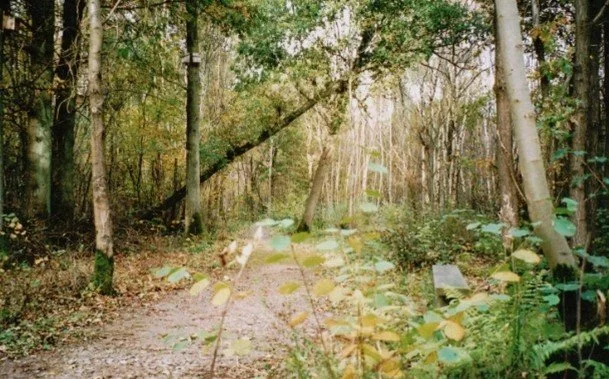
Foalhurst Wood following the collapse of a tree over one of the paths
On the southern border of Foal Hurst Wood was an 11-acre area of meadowland already owned by the parish council. This land was incorporated into the Foal Hurst Wood site and as a result it was possible to provide public access to the wood as well as a car park.
Foal Hurst Wood had been neglected and almost forgotten but work soon began to turn it into a community nature reserve using more realistic plans for the site.
The Foal Hurst Wood Volunteers Group was formed in early 1998 and they commenced caring and managing the woodland for all to enjoy. Expertise was provided by the Kent High Weald Project and British Trust for Conservation Volunteers, whilst a major provider of development funding was the Forestry Commission.
The Woodland was formally opened by the Mayor of Tunbridge Wells on 3 May 1999 and the following pledge was made:
"As custodian of Foal Hurst Wood, Paddock Wood Town Council pledges the continuance of this ancient woodland for the people to enjoy both physically and spiritually".
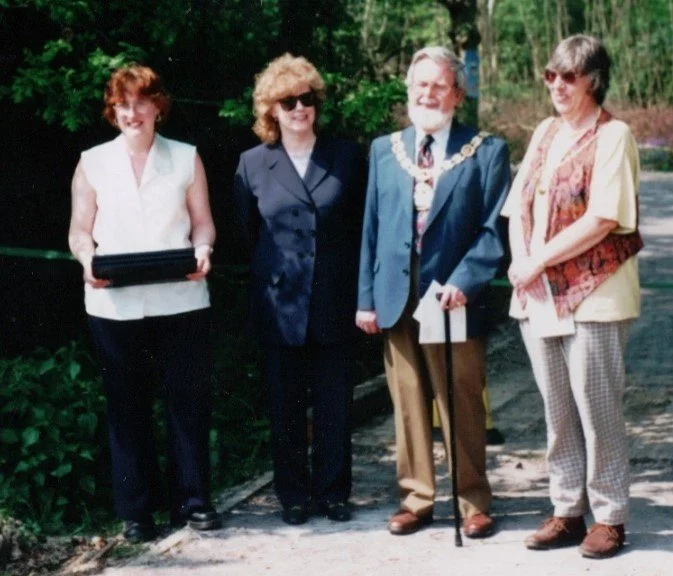
Sue Turk and Elizabeth Thomas representing Paddock Wood Town Council
with the Mayor and Mayoress of Tunbridge Wells
Two months later it was given official status as a Local Nature Reserve by Tunbridge Wells Borough Council and English Nature. Thanks to the Kent High Weald Partnership a trail runs around the perimeter of the wood, whilst a network of footpaths leading from the trail makes it possible to explore the interior.
The wood and it’s surrounding meadows are cared for by a dedicated team of volunteers with ongoing support from Paddock Wood Town Council. Vital conservation tasks include coppicing, managing undergrowth and maintaining ditches, hedgerows and pathways. This is now a thriving habitat for over 2500 species. If you have ever wondered why dogs are not allowed in the wood it is because they are natural hunters and even when on a lead their scent carries throughout the wood and disturbs the environmen
At the end of September 2025 a new noticeboard was unveiled by PWTC to celebrate the 25th anniversary of Foal Hurst Wood nature reserve
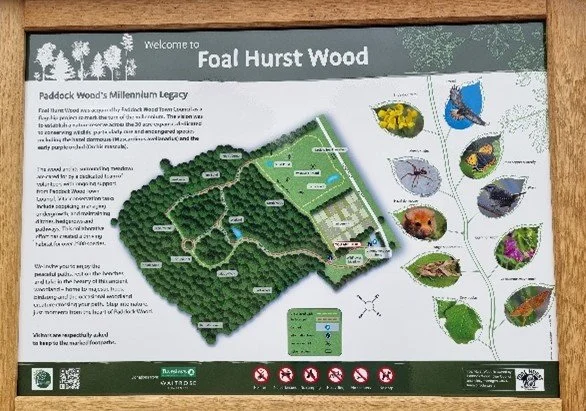
The new sign installed by Paddock Wood Town Council at the entrance to Foalhurst Wood
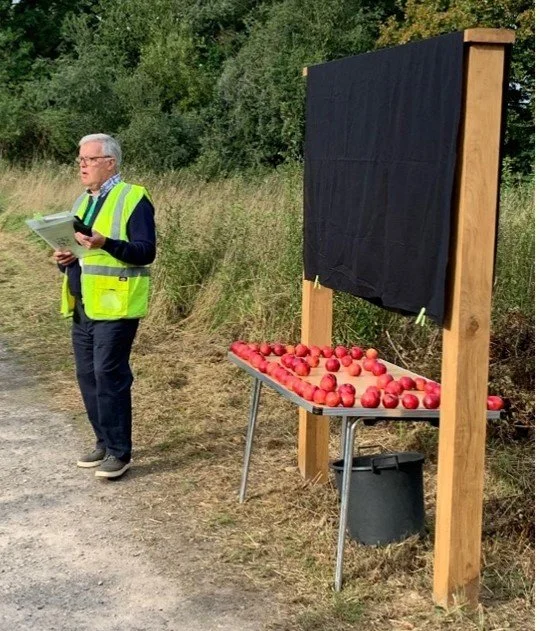
Jeremy Thompson representing PWTC preparing to unveil the sign